Anti-Jewish violence and Rebekka’s father’s death
Narcissus and GoldmundAnti-Jewish violence and Rebekka’s father’s death form one of the Black Death’s defining episodes: a local authority turns fear into collective punishment, and a survivor’s grief forces Goldmund to face the limits of his own compassion. The episode joins the epidemic’s broad social collapse to a specific encounter in which help, presumed innocence, and the desire to rescue someone from death are all called into question.
Violence amid the epidemic
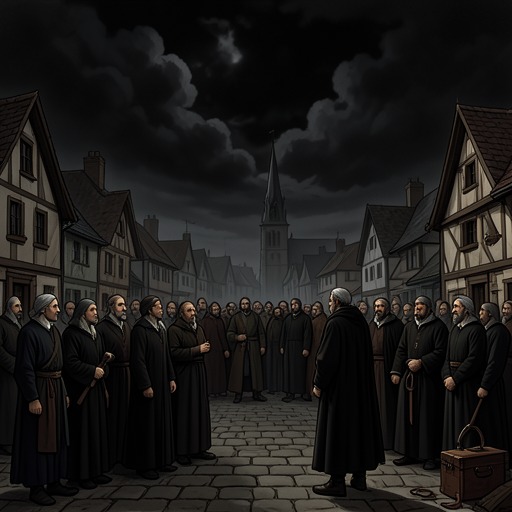
As the plague spread, fear and hardship unsettled ordinary bonds and made communities search for someone to blame. People accused one another of deliberately spreading disease, and Jews, alongside other groups, were made scapegoats. Those suspected of causing the epidemic could be condemned by law or mob; in one town, Goldmund witnessed the ghetto burned, with a crowd preventing people from escaping. The violence against Rebekka’s family belongs to this wider pattern: it is not presented as an isolated dispute but as persecution sanctioned by local authority amid epidemic panic.
The account gives the killing a specific human and communal scale. Rebekka’s father was burned to ash with fourteen other Jews by order of the town’s authorities. She had managed to flee, but later returned to the place where they had been killed. The persecution had taken her father and forced his surviving daughter into danger and isolation; even mourning him required returning to the site of the violence.
Rebekka and Goldmund
Goldmund found Rebekka crouched beside rubble outside a small town, grieving and blaming herself for not having died with the others. He stopped her from hurting herself, listened, and offered protection. At her request, he helped gather her father’s bones from the ashes, carry them to a concealed place in the field, and cover them with earth. The burial is a concrete act of care, but it cannot undo the murder that made it necessary.
Afterward, Goldmund tried to persuade Rebekka to travel with him, presenting his offer as protection from further violence and danger. He promised not to touch her and said she could grieve for as long as she needed. Rebekka rejected the offer. To her, the timing made his courtship inseparable from the help he had just given: a Christian had helped a Jewish daughter bury the father murdered by Christians, then expected the daughter to accompany him. Her accusation makes the encounter’s ethical conflict explicit. Goldmund intended kindness, but his assumption that he could turn protection into intimacy obscured the difference between his intentions and her experience.
Her rejection changed Goldmund’s understanding of the moment. He recognized that he had not understood her grief and conceded that she might be right about him; he apologized and left. He did not rescue her or persuade her to live. The encounter ends with his recognition of a limit, rather than a reconciliation: the person offering aid cannot decide what the bereaved survivor should feel or want.
Witness, responsibility, and memory
The episode returns later when Goldmund recounts Rebekka’s story to Narcissus. The conversation turns on the distinction between ordering cruelty and witnessing it without preventing it. Narcissus says that he might have to tolerate such an act if he lacked the power to stop it, then asks Goldmund whether he prevented the burning he witnessed. Goldmund says that he did not. His story therefore reaches beyond his good intentions toward Rebekka to the harder question of responsibility in the face of violence: seeing an atrocity and grieving over it do not amount to having stopped it.
That question also resists an easy explanation of persecution as a simple consequence of epidemic suffering. The broader account shows how fear can be converted into accusations, sanctioned punishment, and mob violence; Rebekka’s experience keeps the victims and their bereavement in view. Goldmund’s response is neither to defend the Christians who killed her father nor to claim that his assistance repaired their crime. Her words expose the presumption inside his attempted courtship, and her father’s death remains the episode’s irreparable fact.
Narrative significance
The event brings collective violence into focus through its aftermath for one survivor. The community’s order to burn Jews, Rebekka’s return, the burial of her father’s remains, and Goldmund’s later confession to Narcissus form a progression from persecution to mourning to moral self-examination. Rebekka is not merely an image of loss in Goldmund’s journey: her rebuke gives her own judgment decisive force, correcting the role he had imagined for himself as protector.
The episode also tests the novel’s recurring concern with death against the social causes of particular deaths. Goldmund may encounter death as an inescapable part of life, but the killing of Rebekka’s father is not simply an abstract emblem of mortality. It is an act ordered by authorities and sustained by collective hostility. The distinction matters: acceptance of life’s transience does not erase human responsibility for violence, and compassion after the fact cannot substitute for preventing it.